


Te mau faatitiaifaroraa toro'a i ni'a i te mau rave'a, Te taata faatere no te hu'ahu'a, Te mau hu'ahu'a rahi, CLC e haafifi i te mau tao'a tahi, e te mǎshini hu'ahu'a


I watched the floor of a high-end restaurant crack six months after installation. The tiles were perfect. The grout lines, however, were a spiderweb of failures. The client wanted a “parau parau” grout, but the installer used a standard cement mix with a cheap liquid latex additive. It was a predictable disaster. That failure wasn’t about poor workmanship. It was a fundamental misunderstanding of materials. True flexibility in grout doesn’t come from wishful thinking or a bottle of latex. It is engineered. The cornerstone of that engineering is a dry, free-flowing powder you add to the mix: redispersible polymer powder for flexible tile grout. This is how you use it correctly.

The Polymer Principle: Why Powder Beats Liquid
Forget everything you know about liquid additives. Redispersible polymer powder for flexible tile grout starts as a polymer emulsion that’s spray-dried. When you mix this powder with water, the particles redisperse, recreating a polymer film within the cement matrix. This film does three critical things. A tahi, it binds cement particles together with flexible, organic bridges. This dramatically increases tensile strength and adhesion. Second, it fills microscopic pores. This reduces water absorption by over 70% compared to unmodified grout. Third, the polymer film absorbs and dissipates energy from thermal expansion, substrate movement, and foot traffic. The grout gains elastic memory. It bends instead of breaking.
Taahiraa-i-te-taahiraa: Building an Unbreakable Joint
Success depends on your process. Follow these steps precisely.
Tā'amu 1: Select the Right Redispersible Polymer Powder. Not all powders are equal. You need a powder designed for cementitious tile grouts, typically a Vinyl Acetate Ethylene (URU) copolymer. Check the technical data sheet. Look for a minimum polymer content of 98%. The powder must be free-flowing, with no visible lumps. For a standard flexible grout mix, you will need between 1.5% a 3.0% polymer powder by weight of the total cementitious material (sima + pau). For a 25 kg bag of grout base, this means adding 375 a 750 grams of polymer powder.
Tā'amu 2: The Dry Blend is Sacred. This is the most common mistake. You cannot add the powder to wet mix. Pour your dry cement-based grout powder into a mixing container. Add the precisely weighed amount of E nehenehe e parare faahou me'a powder for flexible tile grout. Use a mechanical paddle mixer on a low speed for three to five minutes. You must achieve a perfectly homogeneous, uniform color. No streaks.
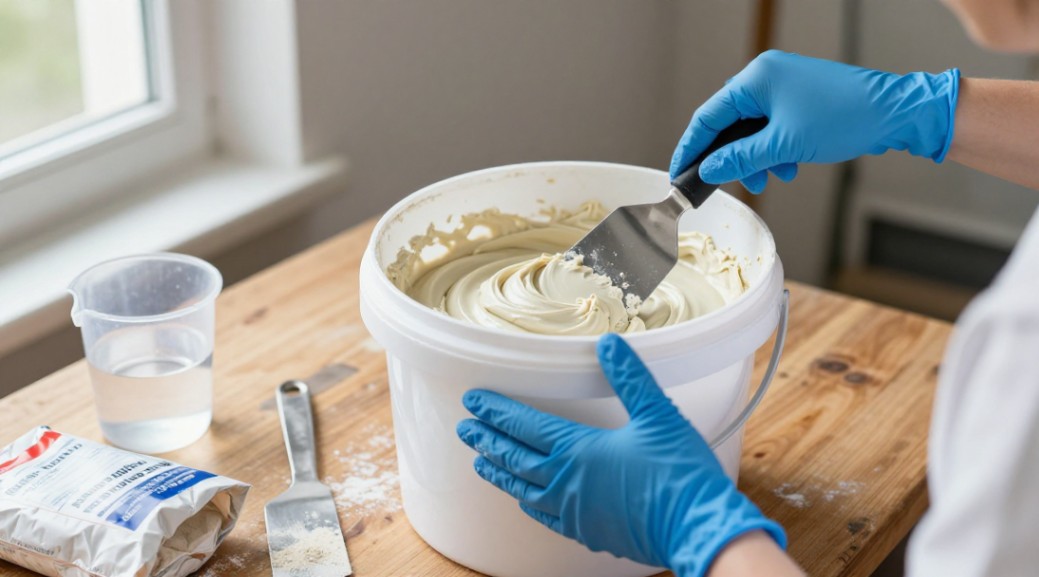
Tā'amu 3: Controlled Wet Mixing. Now add clean, cold vai. Follow the grout manufacturer’s water ratio, but start with 10% less. The polymer powder will increase workability. Mix for two minutes, scrape the sides and bottom, then mix for another two minutes. The consistency should be smooth, creamy, and lump-free. Let the mix slake (Fa'aora) for five minutes. Remix for one minute before application.
Application: Where Flexibility Earns Its Keep
Apply your polymer-modified grout with a firm rubber float, forcing it completely into the joints. The improved adhesion and workability make this easier. Clean-up is faster because the surface film is more cohesive. The real test comes later.
In underfloor heated floors, the constant thermal cycling stresses the grout. A standard grout micro-cracks. The polymer-modified grout flexes. On exterior balconies, freeze-thaw cycles and UV exposure break down ordinary grout. The polymer film resists water ingress and provides superior durability. In wet rooms and showers, the drastically reduced water absorption prevents mold-friendly dampness and efflorescence. This isn’t an incremental improvement. It changes the performance category of the installation.
The Uncompromising Comparison
Let’s be blunt. A standard cement grout is a brittle, porous matrix. It survives in static, perfectly controlled environments. The modern building is not static. Wood substrates move. Concrete cracks. Temperatures swing. A grout modified with redispersible polymer powder is a composite material. It is tougher, more adhesive, and hydrophobically tuned. The cost difference per square meter is negligible. The risk reduction is monumental.

Your next project demands more than filler between tiles. It demands a joint system that actively contributes to the longevity of the installation. Start with the right powder. Follow the process. The result isn’t just flexible grout. It’s peace of mind, engineered into every line.
Suppler
O tatou te ti'a faatere o te ao nei i roto i te mau rave'a no te faatitiaifaro i te mau rave'a hamaniraa tauihaa. Ua matau - maitai - hia oia na te ao nei no to ' na fafauraa i te maimiraa, Fa'aterehia, e te ite aravihi, mai te omuaraa mai â o te mau matahiti 2012 mai â, ua horo'a matou i te mau rave'a no te faatitiaifaro i te mau fifi.
Na te ao taatoa nei, e nehenehe ta tatou e horo'a i te mau tao'a faaineineraa ti'a teitei e te mau tao'a hu'ahu'a.
E tuhaa ohipa aravihi to te taiete e te hoê tuhaa fenua no te hi'opo'araa i te maitai, te hoê piha maimiraa tei faaineine-maitai-hia, e te mau rave'a hi'opo'araa aravihi e te hoê pû taviniraa i muri a'e i te hooraa.
Mai te mea e, te anaanatae ra outou, A faaite mai ia matou.